Optical Spectra
Quasar Narrow Line Region and Optical Spectra
Quasar optical spectra show strong blue continua and broad emission lines with velocity widths of thousands of km/s, indicating gas close to the supermassive black hole. In addition to broad lines, narrow forbidden lines are present with smaller velocity widths, suggesting low-density gas at larger host-galaxy scales.
In this work, I analyzed narrow-line properties across redshift and at different levels of continuum luminosity and broad Balmer-line width, both of which can partly trace accretion state.
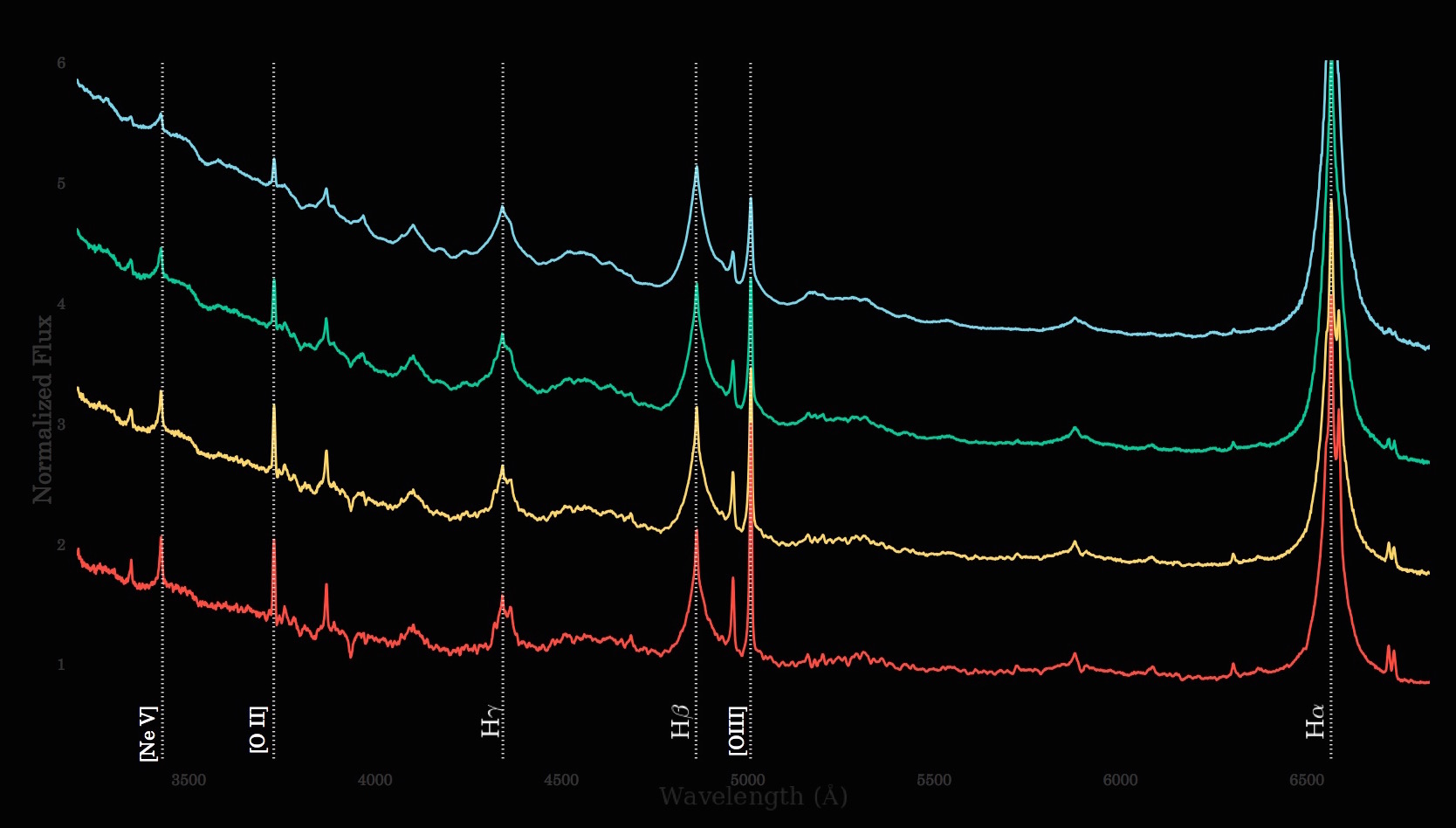
Optical quasar composite spectra from Tammour et al.
UV Spectra
Quasar Winds Probed Through UV Spectra
Quasar UV spectra show signatures of outflowing winds through blueshifted emission and broad absorption features, especially in CIV. These winds can reach very high velocities and are central to understanding quasar feedback and line-of-sight orientation effects.
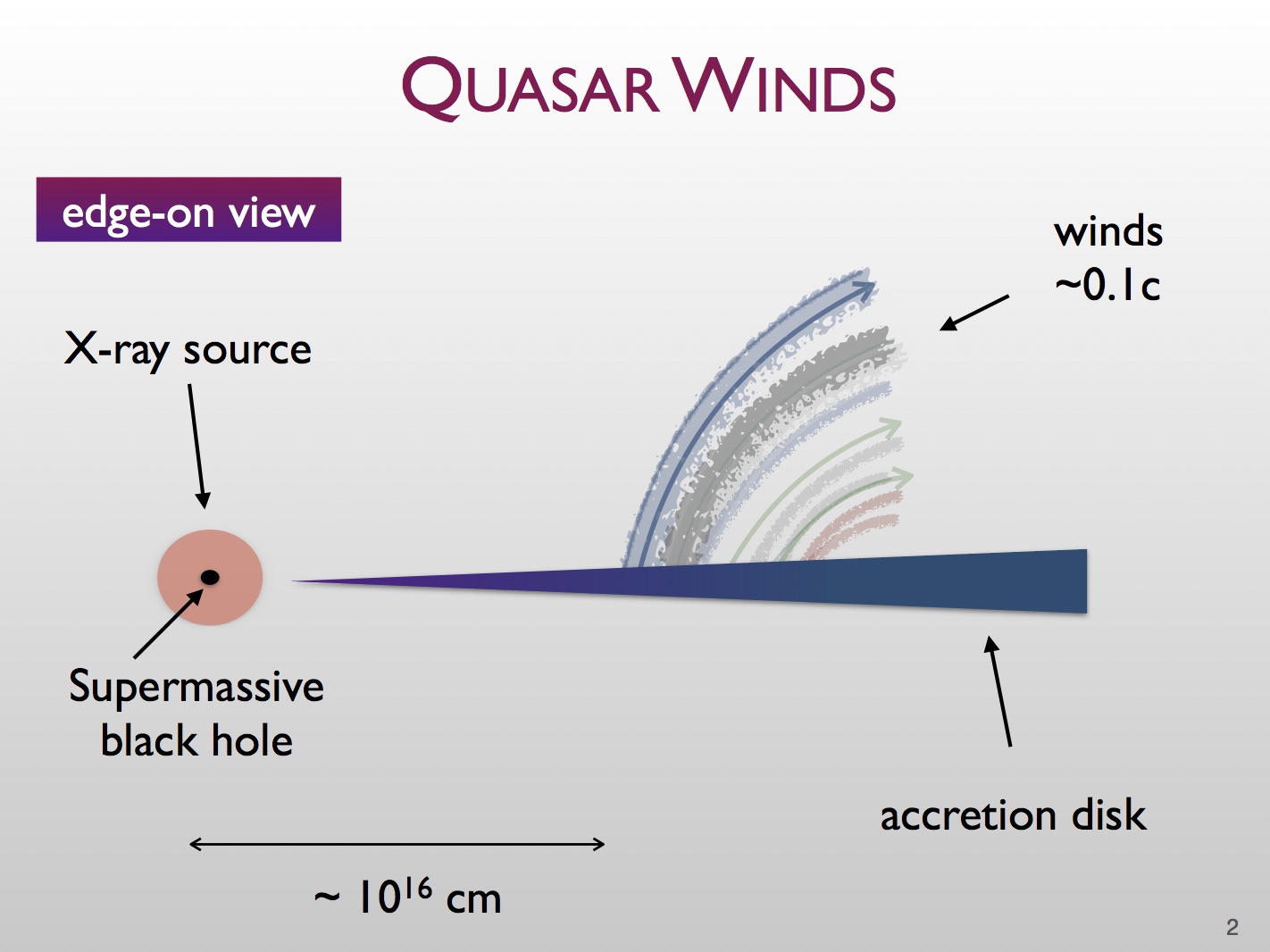
Accretion disk winds accelerated by UV photons.
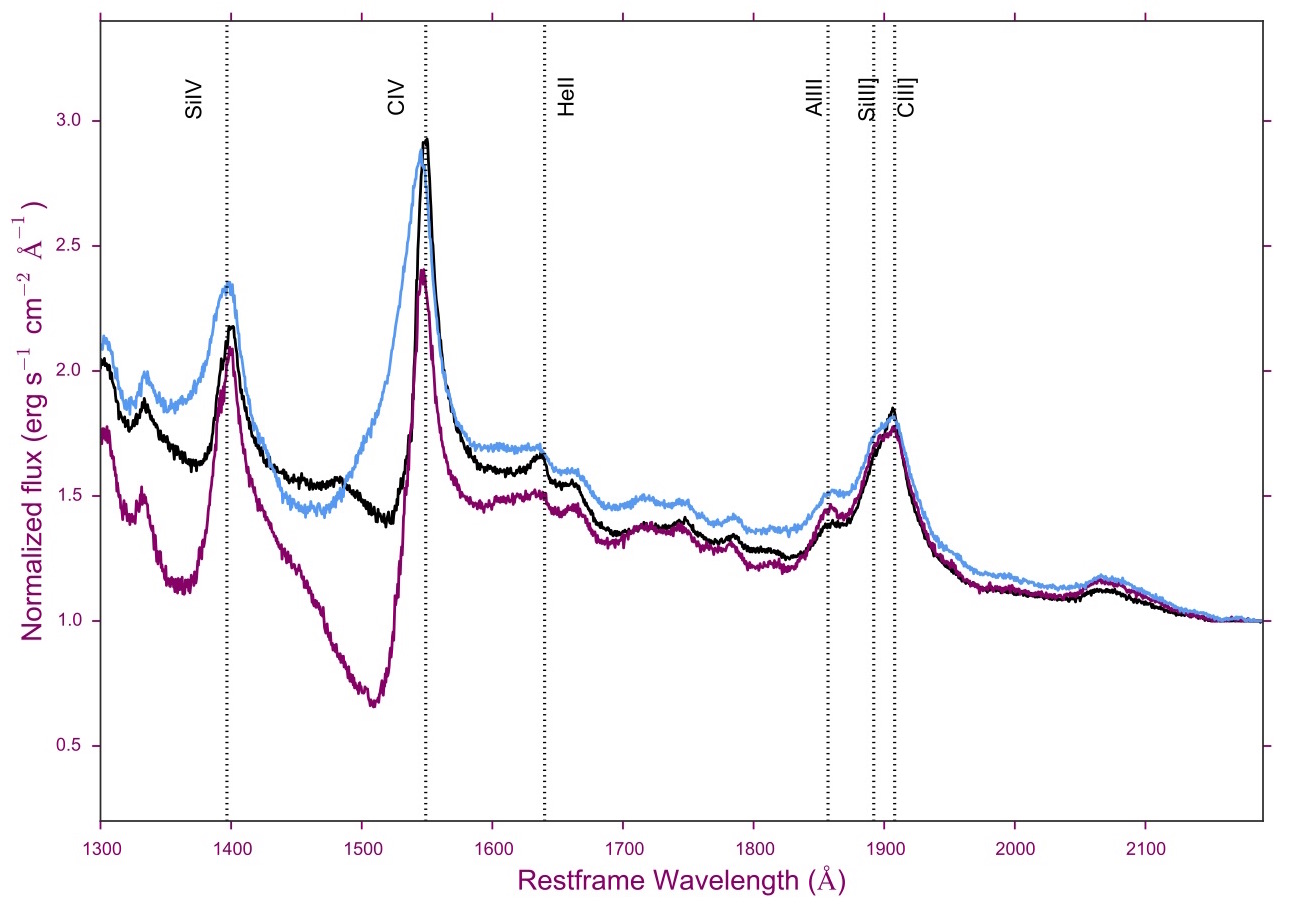
Composite spectra for broad absorption line (BAL) quasars.
Machine Learning
Unsupervised Clustering of Quasar Spectra
Unsupervised clustering is a powerful way to probe high-dimensional astronomical data without assuming predefined classes. During my PhD research, I used clustering methods to identify structure in quasar UV spectral parameter space using both high- and low-ionization lines.
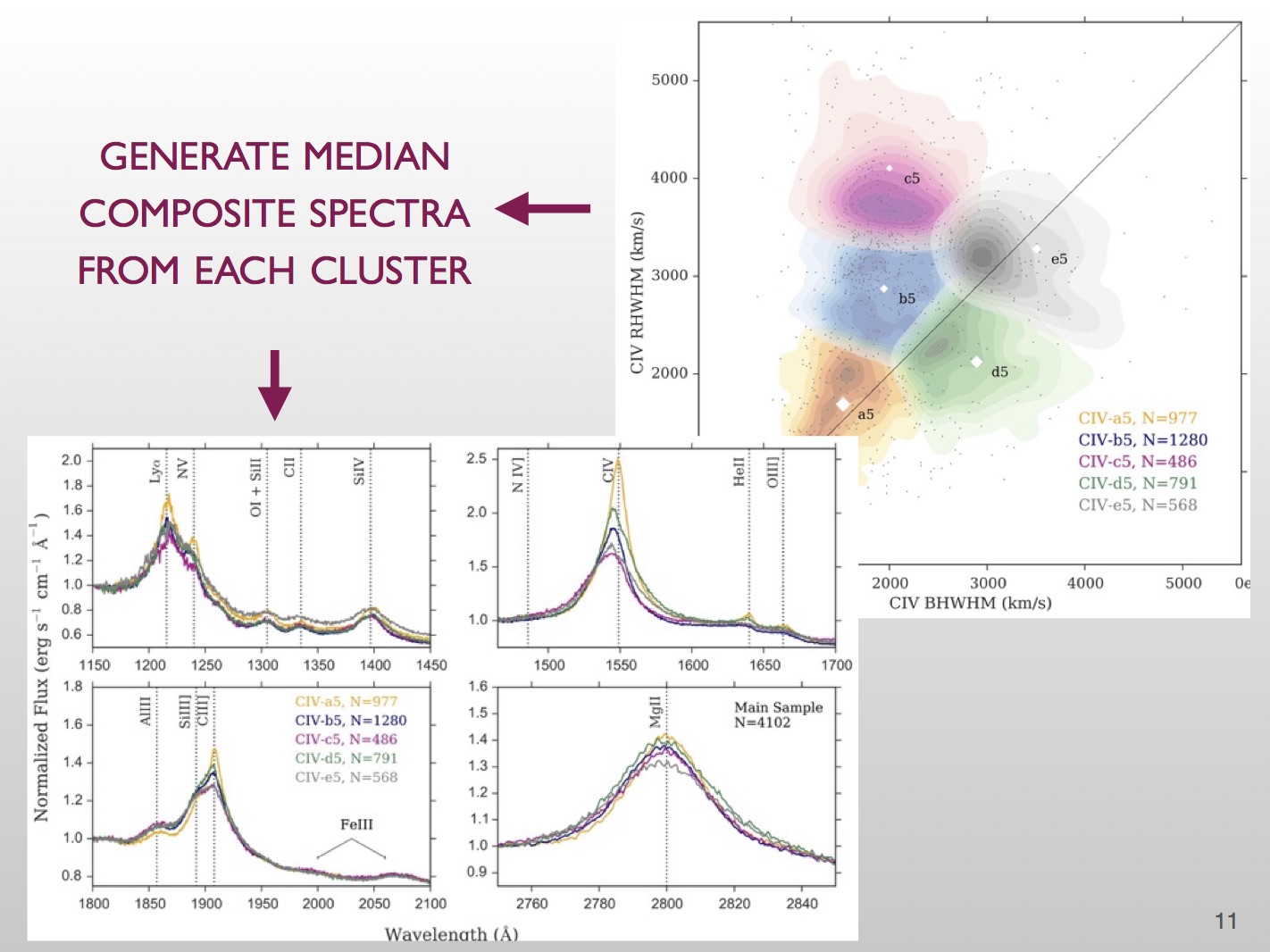
Clustering analysis of quasar UV spectral properties.
Publications
Selected Publications
-
Tracing quasar narrow-line regions across redshift: a library of high-S/N optical spectra , Tammour, A. et al., 2015, Monthly Notices of the Royal Astronomical Society, 448, 3354.
-
Insights into quasar UV spectra using unsupervised clustering analysis , Tammour, A. et al., 2016, Monthly Notices of the Royal Astronomical Society, 459, 1659.